The Great(1): Had a rip-roaring good time at the very swanky Haynes Whaley open house. Amy, Kim, you girls deserve a big fat raise. What a great event; I heard several people thank and congratulate Larry. He owes you ladies BIG TIME!!!
It was wonderful to catch up with Andrea; I encourage you to keep on doing what you're doing. It will pay off.
Kim, who knew a couple of martinis could go to such good use :p We'll be proud to call you a member, sign up immediately, girl!!!
The Great(2): Unexpected deadline extension. No work this weekend! Yahoo!
The Ugly: My subdivision newsletter describes us as "A family community in FAR WEST Houston". That makes me livid! I'm an urban dweller by nature. I feel like a hamster in a llama pen. I need to get out of the sprawl, any ideas, anyone?
Thursday, May 11, 2006

Wednesday, May 10, 2006
In no particular order
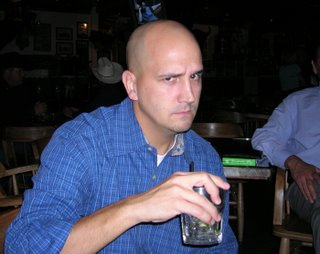
Matt, attempting a sexy pose, but looking like, well, Matt. Sorry dude, we love you anyway...
The band. Don't know who they were but they sounded darn good. They even sang my favorite: Satisfied by Ian Moore, who'd ever have thunk it!

Don't ask; you had to be there....
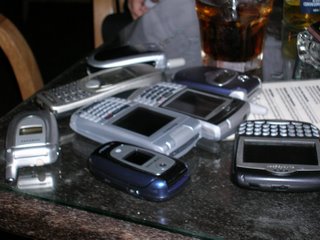
Here are the stragglers several margaritas later. A little worse for wear after tripping over uneven paving and armadillo tails...
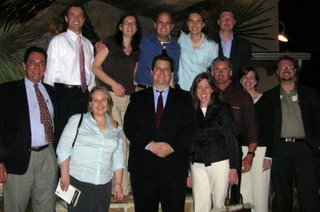
Sara, attempting to do a sexy pose, caught by the camera pre-pucker looking like a playboy centerfold. New marketing award for 2007: Sexiest Marketer of the Year. You hot babe, you!


The band. Don't know who they were but they sounded darn good. They even sang my favorite: Satisfied by Ian Moore, who'd ever have thunk it!

Don't ask; you had to be there....
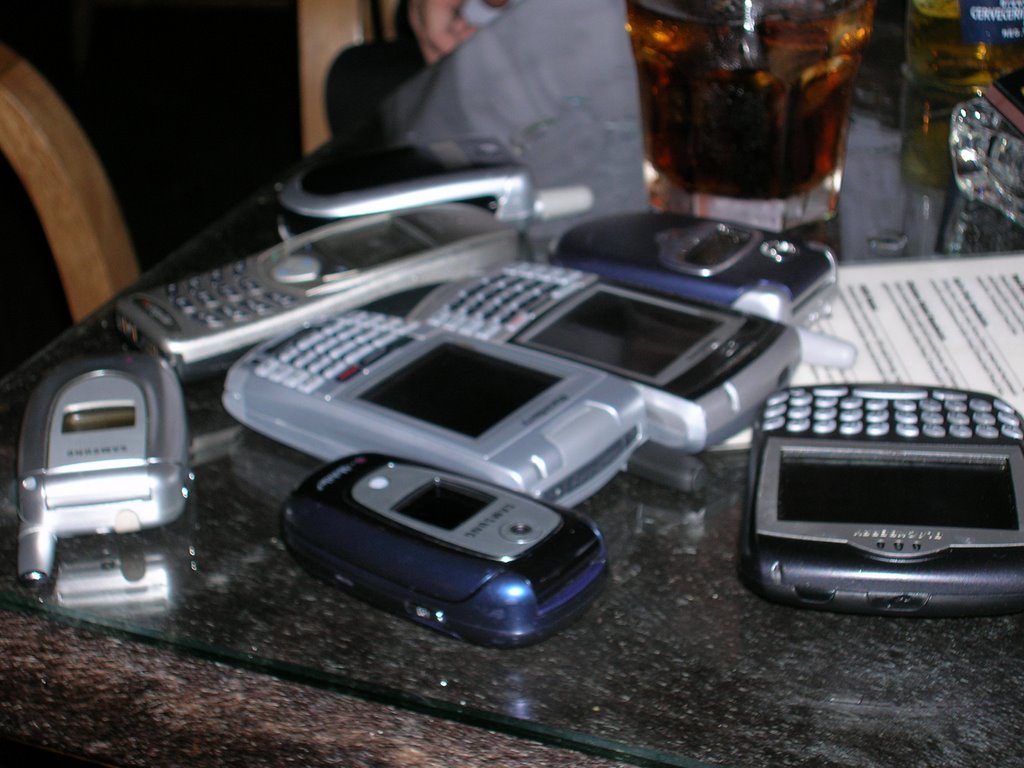
Here are the stragglers several margaritas later. A little worse for wear after tripping over uneven paving and armadillo tails...

Sara, attempting to do a sexy pose, caught by the camera pre-pucker looking like a playboy centerfold. New marketing award for 2007: Sexiest Marketer of the Year. You hot babe, you!

Tuesday, May 09, 2006
Milk, no sugar
Well, it looks like this weekend won't be so much fun... duty calls, again. It gets kind of frustrating when you have to put work before everything else for an extended period of time(including the last weekend you get to spend with your son for four weeks). After the $hitty week I had last week I was looking forward to a break from the stress of deadlines and those who thrive on last minute preparations, but I don't think that will be happening. All that makes me smile was not lost from my day however, I did get to visit with the always frank, genuine and helpful Councilmember Brown in none less than Mayor Whit e's cloakroom! Fancy that. We had to extract Mr. Brown from his council meeting, which meant a trip to the depths of City chambers, and the only meeting space available was ol' Bill's green room :) FYI those of you who've never visited City Hall, it's decorated in a very weird art-deco fashion. Not that art-deco is weird, it just doesn't seem like the style one would choose to adorn a public building for years and years. Not my cup of tea at all. In fact, it's kind of like adding two spoons of sugar; why would anyone do that?
P.S. I won't waste an apology to those of you who think Peter Brown isn't worth a second kipper at breakfast; I happen to like the man.
 e's cloakroom! Fancy that. We had to extract Mr. Brown from his council meeting, which meant a trip to the depths of City chambers, and the only meeting space available was ol' Bill's green room :) FYI those of you who've never visited City Hall, it's decorated in a very weird art-deco fashion. Not that art-deco is weird, it just doesn't seem like the style one would choose to adorn a public building for years and years. Not my cup of tea at all. In fact, it's kind of like adding two spoons of sugar; why would anyone do that?
P.S. I won't waste an apology to those of you who think Peter Brown isn't worth a second kipper at breakfast; I happen to like the man.
Saturday, May 06, 2006
Power to the people!
Saturday started out very ominously. I woke up to the alarm at 5:30, set up in bed and the power promptly went out. Not wanting to miss any of the activities I had planned for the day I put my best Girl Scout foot forward and showered by candelight (not very romantic when solo). Things were going well until I realized that the power wasn't going to reestablish in time for me to blow-dry my hair (horror!). So at 7:00 I left the house in a semi-frizzy state, only to face the fact that my car was trapped in the garage. Noooooooooo! What would Brown Owl do? Okay, there's a piece of rope attached to the pulley system, maybe if I pull on it it will... break the metal lever that retracts as the automatic opener kicks in. $hit! Stay calm, think, think, oh, maybe I can just lift the door up. Ta-da!
After blow-drying my hair with the car heater on max while driving down I-10, things started to turn around.
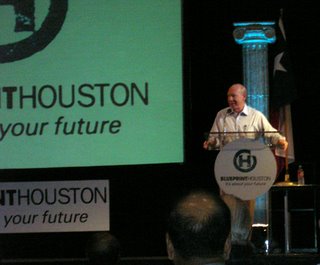
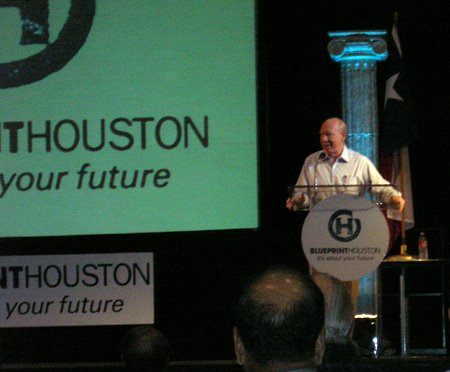
I picked KC up and we headed to the George R. Brown for my first Blueprint Houston meeting. I didn't really know what to expect. We were grouped by tables of 9 where we listened to speakers, facilitators and even our wonderful Mayor, and periodically brainstormed about various city issues including flooding, developing successful neighborhoods, transportation corridors and parks. We were lucky to sit at a table with such a great group of people; everyone was already heavily involved with Blueprint or was in the design industry so knew the options and terminology that were being flung around the table. We were asked set questions and given the chance to answer using a key pad (as modeled below by the lovely Miss K), the answers were instantly shown on the screen so we all had a chance to see which way the room was swinging. It was fascinating, I can't wait to go back for more. Even though I got the feeling that the questions were loaded, and the group hired to process the input and ideas given by the public seemed to be angling the previous years answers to suit their desired scenario outcome, I did feel like I was contributing something to this city I love so much, and also learnt a lot from the little effort it took to make it there.

After the meeting KC and I went across to the orchid show. Now, KC is the big orchid fan here, but guess which one of us ended up spending money, hmm? While she didn't see anything that caught her eye, I spotted a hoya plant, which I had to scoop up immediately. My grandmother had a hoya in her sunroom, it produces the most fragrant tiny flowers which develop a nectar that as a kid I used to devour every chance I got. It was so reminiscent that I had to buy it. Luckily it's a pretty hardy plant so I may manage not to kill it. Here are some of the orchids...





After walking around for a while we decided we were famished so headed of for sushi. As always it was incredible; Sushi King is the best...
I dropped K off at home and headed down to the MFAH for a showing of Lagaan: Once Upon a Time in India. Great Bollywood movie, an incredibly moving tale of faith and courage. It actually made me rethink a very important current news issue, but that's for me to know and keep to myself. Revelation. Thanks to GC for suggesting it and for the company. How about that free beverage!
After blow-drying my hair with the car heater on max while driving down I-10, things started to turn around.
I picked KC up and we headed to the George R. Brown for my first Blueprint Houston meeting. I didn't really know what to expect. We were grouped by tables of 9 where we listened to speakers, facilitators and even our wonderful Mayor, and periodically brainstormed about various city issues including flooding, developing successful neighborhoods, transportation corridors and parks. We were lucky to sit at a table with such a great group of people; everyone was already heavily involved with Blueprint or was in the design industry so knew the options and terminology that were being flung around the table. We were asked set questions and given the chance to answer using a key pad (as modeled below by the lovely Miss K), the answers were instantly shown on the screen so we all had a chance to see which way the room was swinging. It was fascinating, I can't wait to go back for more. Even though I got the feeling that the questions were loaded, and the group hired to process the input and ideas given by the public seemed to be angling the previous years answers to suit their desired scenario outcome, I did feel like I was contributing something to this city I love so much, and also learnt a lot from the little effort it took to make it there.

After the meeting KC and I went across to the orchid show. Now, KC is the big orchid fan here, but guess which one of us ended up spending money, hmm? While she didn't see anything that caught her eye, I spotted a hoya plant, which I had to scoop up immediately. My grandmother had a hoya in her sunroom, it produces the most fragrant tiny flowers which develop a nectar that as a kid I used to devour every chance I got. It was so reminiscent that I had to buy it. Luckily it's a pretty hardy plant so I may manage not to kill it. Here are some of the orchids...


After walking around for a while we decided we were famished so headed of for sushi. As always it was incredible; Sushi King is the best...
I dropped K off at home and headed down to the MFAH for a showing of Lagaan: Once Upon a Time in India. Great Bollywood movie, an incredibly moving tale of faith and courage. It actually made me rethink a very important current news issue, but that's for me to know and keep to myself. Revelation. Thanks to GC for suggesting it and for the company. How about that free beverage!

Sorry to K and M that I was a no-show at Blues on the Bayou. KC, I had a great time with you; your energy and enthusiasm are an inspiration. Thanks : )
Viva Juárez!
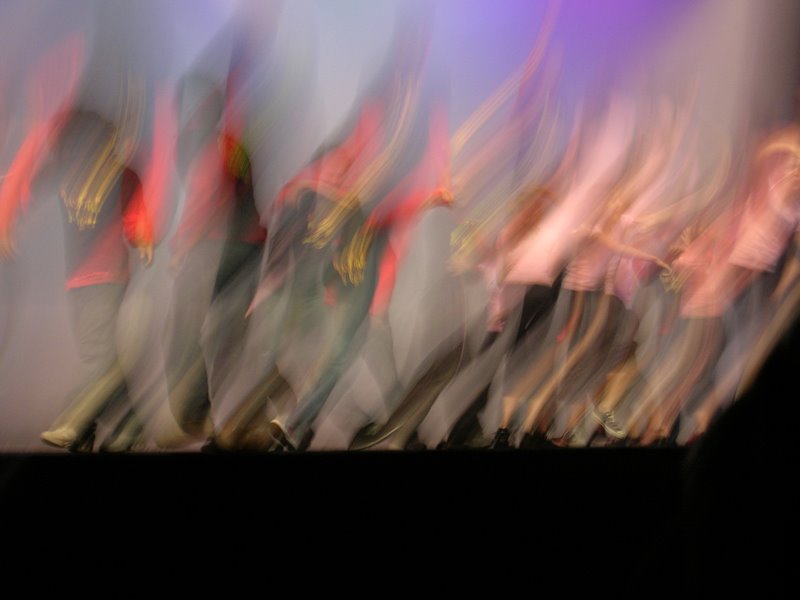
After an extremely stressful week at work, some R&R was overdue. May I express my thanks to the Mexican people for Cinco de Mayo! The fun began at WS High, where several dance classes, including Miss L's performed for our entertainment. Included in the line-up was the national competition winning group, Inertia, who were amazing.

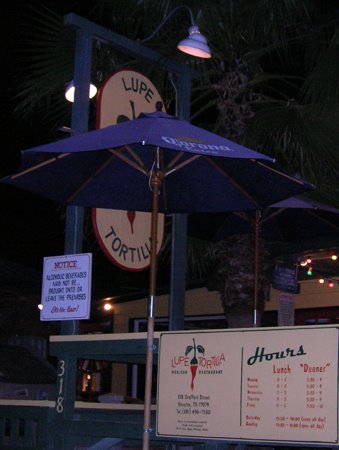
After the recital, AP and I took off for a little south of the border celebration of our own. Unfortunately, Lupe Tortilla was not rockin'. I think one of the regulars recently died, so everyone was somber and sober. Fortunately they forgot to mention it to us; we had a heck of a time...


After the recital, AP and I took off for a little south of the border celebration of our own. Unfortunately, Lupe Tortilla was not rockin'. I think one of the regulars recently died, so everyone was somber and sober. Fortunately they forgot to mention it to us; we had a heck of a time...
Thursday, May 04, 2006
Anyone know what this plant is called?

It came up with a bunch of wildflower seeds scattered in my back yard.
I found both the flower and the leaves to be particularly beautiful.
Crawfish are my friends

When you see me devour a plate of them you'd never guess I have one as a pet.
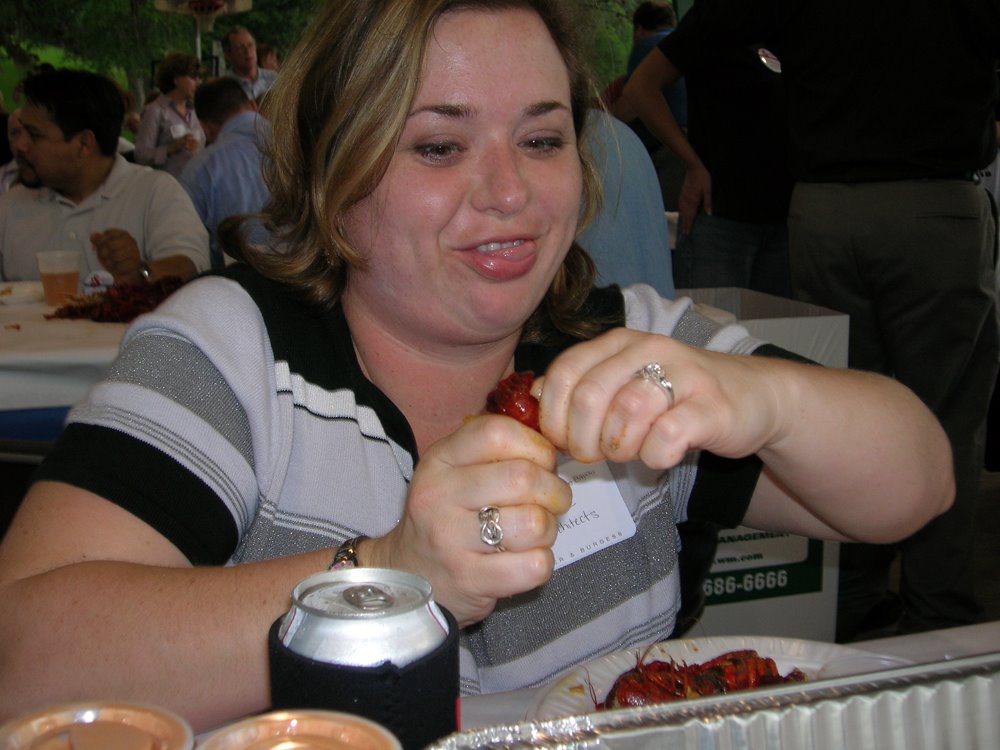 Here's Jill, a mud-bug virgin, at the Carter & Burgess Annual Seafood on the Bayou Bash.
 When it rains, it pours (not very obvious in this picture). We were so grateful to be under such a solid steel structure during a lightning storm. Hmm.
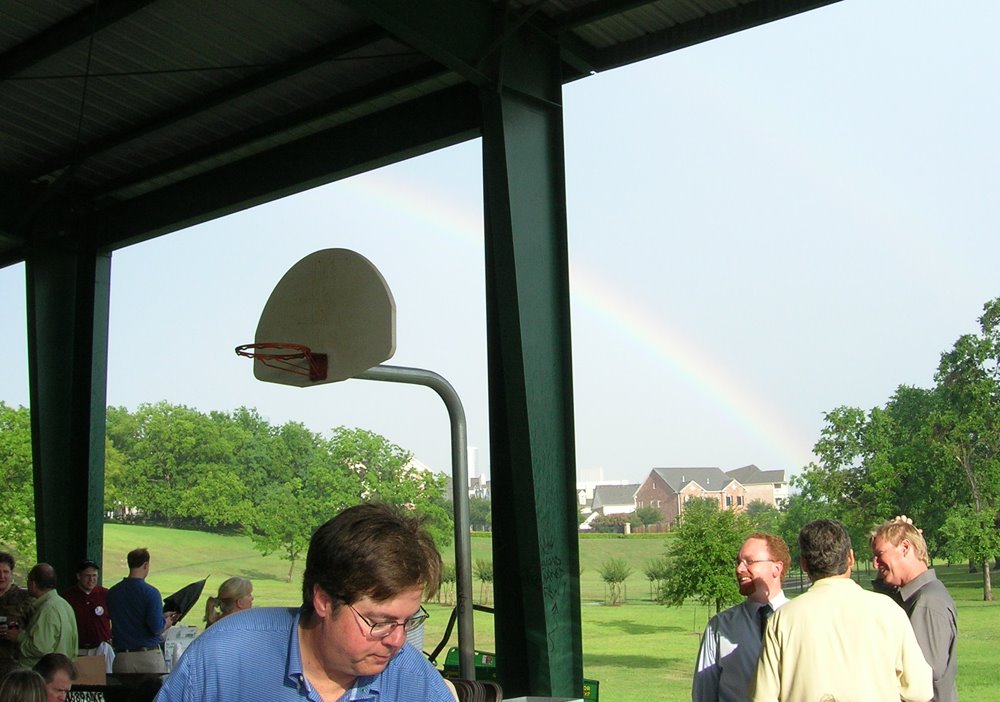 And moments later the sun comes out. We didn't find a pot-o-gold...
but we did come across another cold-one.
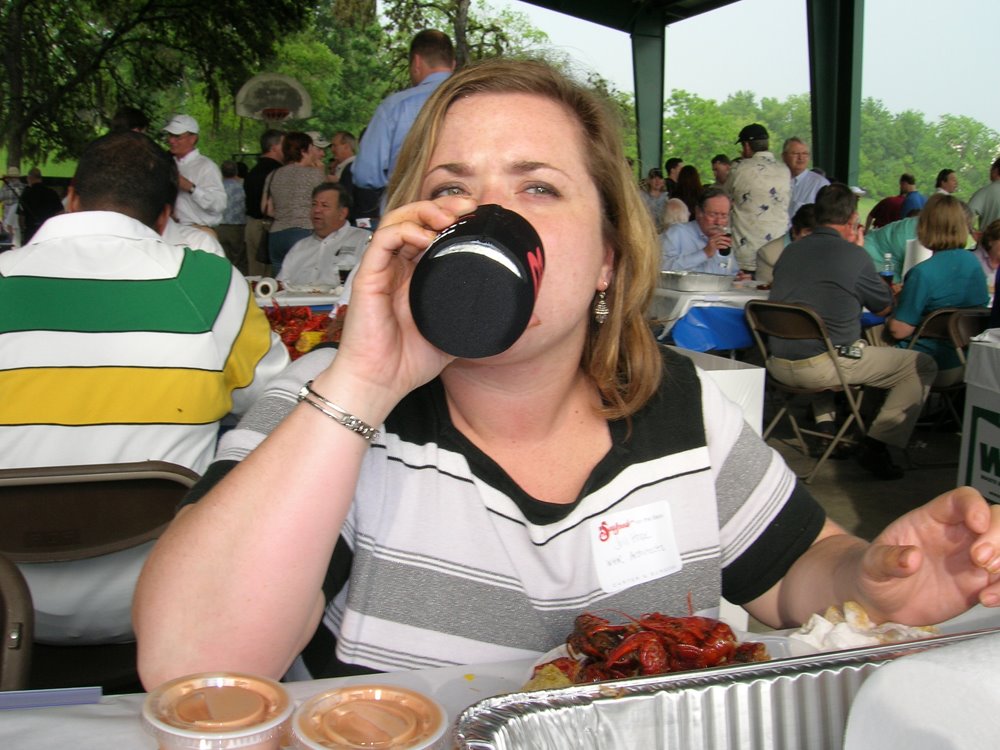 Cheers!
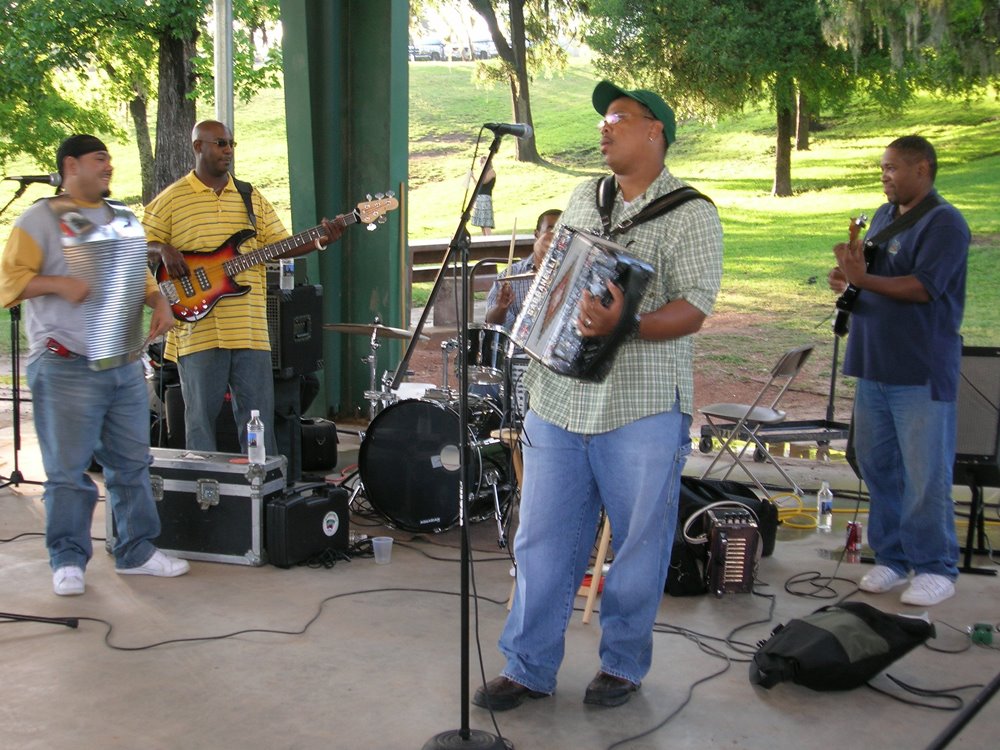 The Zydeco Leprechauns kept us entertained. Wait, no, that was Jill and her hilarious ghetto mama impersonations, but to give the band credit, they were pretty good too. A good time was had by all. Even Councilman Brown.
Sunday, April 30, 2006
Haydn Vitera Band


Listen out for this name: Haydn Vitera. Remember I told you one day he would be a world famous musician...check out his myspace page. He sings, he plays guitar and piano, he trained for 8-years on the classical violin and now plays fiddle for several recording artists. One day, Haydn will make it big, and he's Andres' cousin, that's why we're routing for him...
Where's the Jambalaya?


After a good rain on Friday, the bayou was up higher than I've seen it in a long while in our neighborhood. CDVN and I bought a 5-ft handled net because last time we ventured down there we tried to catch some very cool neon blue guppies that were happy to sit just out of our reach. Because of the rain, all wildlife had decided against making an appearance this weekend, but we did catch a glimpse of a beautiful Great Blue Heron, darker than any I've seen before, but it was smaller too, so maybe a youngster...
Then there were three...
 Leftist trio seals Americas pact
Socialist presidents of Latin America uniteThe left-wing leaders of Bolivia, Cuba and Venezuela have signed a three-way trade agreement aimed at countering US influence in Latin America.
Read full story on BBC America here.
Wednesday, April 26, 2006
King Ranch exhibition
 Anyone who feels at home in Texas as I do should pay tribute to Helen Kleberg and Toni Frissell, two women who captured the essence of ranch life during the 40's and 50's, by visiting The King Ranch exhibit at the Museum of Fine Arts Houston. Great collection, made me want to turn back the clock...
April 25, 2006
Obituaries; Jane Jacobs, 89; Urban Theorist, Community Activist Who Fought Lower Manhattan Freeway Plan Mary Rourke, Times Staff Writer Jane Jacobs, an urban theorist and community activist whose books argued for the rehabilitation of neighborhoods on traditional lines, breaking with emerging trends in city development, died Tuesday. She was 89. An American-born citizen of Canada, Jacobs died at a hospital in Toronto of natural causes, according to publicist Sally Marvin of Random House, Jacobs' publisher. Jacobs was admitted to the hospital late last week and had been in failing health for several years. She was internationally known as an advocate of cities with distinct neighborhoods, built to a human scale, mixing commercial and residential space. She was against building highways that cut through city centers and was once arrested at a public hearing after she stormed the podium to express her opposition to a plan for an expressway through lower Manhattan. "Jane Jacobs' thinking about cities was clear and it came from a person who lived in cities," Toronto Mayor David Miller told The Times on Tuesday. "She didn't just write about urban issues. She acted on her convictions." Jacobs' most influential work, 1961's "The Death and Life of Great American Cities," set the stage for a battle that Jacobs waged for decades. Defying popular theories on how to renew city slums by plowing them under and replacing them with uniform housing projects, she pushed for recycled buildings and new structures scaled to the existing neighborhood. Her feisty prose often read like a manifesto. "This book is an attack on current city planning and rebuilding," she announced in the opening paragraph of "The Death and Life of Great American Cities." She continued: "It is also, and mostly, an attempt to introduce new principles of city planning and rebuilding, different and even opposite from those now taught in everything from schools of architecture and planning to Sunday supplements and women's magazines." In her view a successful city needed vibrant neighborhoods linked by public transportation. Each area needed its own mix of old and new buildings, a constant influx of smaller, independent businesses, and a range of residential and commercial space. Early critics accused her of being short on realistic solutions to the challenges of urban life. Admirers called her a maverick and a comprehensive thinker. Thirty years later, when her books were required reading in graduate school programs and many of her beliefs about cities were widely accepted, she was praised as a visionary and a pivotal figure in her field. "It's not that the world was one way before Jane Jacobs and changed 180 degrees because of her," Paul Goldberger, architecture critic of the New Yorker magazine, said in an interview with the Los Angeles Times in 2003. It was more a case of Jacobs daring to voice her complaints in a firm, public manner. "Nobody else spoke out against the establishment the way Jacobs did," Goldberger said. "In the '50s, American cities were generally considered messy, undesirable things. Suburban life was considered the ideal. Jane Jacobs fought valiantly in defense of plain, old-fashioned, urban life." She was opposed to the use of bulldozers as a tool for urban renewal. "From her point of view," Goldberger said, "nothing was being renewed. It was all being destroyed." Referring to Jacobs' "The Death and Life of American Cities" as "arguably the most important book written about cities in the 20th century," he summed up her attitude toward tear-down renewal: "The emperor of city planning has no clothes." As a writer and community activist, Jacobs' energy was unrelenting. She challenged the views of influential thinkers such as historian Lewis Mumford, author of "The Culture of Cities." Her most audacious outburst came in the 1960s when New York City planner and power broker Robert Moses announced his plan for an expressway through the Washington Square area in lower Manhattan. Jacobs attended the public hearing where she and other protesters vocally opposed the plan. "He was one of the first speakers," she recalled of Moses, in a 2000 interview with the Associated Press. "He was furious and he stood up there, inside the railed enclosure, and not where most speakers spoke -- outside where the public microphone was. He was privileged. "He gripped this railing and he said, in dismissing scornfully our plan to have no more than the existing road and better not even that, he said, 'These protests are just by a bunch of ... a bunch of mothers!' " Jacobs, joined by other protesters, then rushed the podium, disrupting the meeting. She was arrested on several charges, including criminal mischief, which established her as a terror, at least around City Hall. It also reduced to rubble any view that Jacobs was merely a disheveled, jolly-faced lady with the big, round glasses. Rather, she was "a far-sighted genius who guided cities in new directions," Robert Caro, who wrote a biography of Moses, told the Associated Press on Tuesday. Her battle with Moses was "one of the truly heroic sagas in the history of New York," Caro said. Jacobs first staked her claim as the bane of the establishment in 1961 when she led the opposition against a tear-down plan for her West Village neighborhood in lower Manhattan. Redevelopers intended to take out the brownstones and small apartment complexes in the area and replace them with a housing project that covered several blocks. She argued against demolition and offered her own proposal, which preserved existing housing and added a middle-income apartment complex built to scale. Eventually, the plan she helped devise was approved. "In the '60s, technocrats were leading the way in urban planning," architect Eric Owen Moss told The Times in 2003. His Los Angeles-based firm has recycled office space for housing and blended recycled buildings with new structures in the Jacobs tradition. "Jacobs was a unique, sensitive voice for a different point of view," Moss said. "The technocrat said, 'We'll put an expressway here, a dam there, a high-rise here'. She said, 'Let's not build the expressway through peoples' backyards. Let's keep the continuity of the existing neighborhood. And let's have parks.' " Forty years after she helped defeat plans for an expressway through lower Manhattan, Jacobs was still receiving phone calls from community activists across North America, seeking her guidance. In 2000, concerned citizens of Pittsburgh wanted to block a redevelopment project that would have wiped out two of the city's downtown streets. Jacobs offered coaching by phone, and the Pittsburgh activists won their battle. Her credentials for the role of urban strategist were comparatively sparse. Born May 4, 1916, in Scranton, Pa., she graduated from high school and worked briefly as a reporter on the Scranton Tribune before she moved to New York City. There she attended classes at Columbia University but did not complete her college degree. She went to work as a freelance journalist covering urban issues. In 1952, she was hired by Architecture Forum magazine. She became a senior editor and remained on the staff until 1962. In her essay, "Downtown Is for People," included in the book, "The Exploding Metropolis" (1958), Jacobs suggested ways to revitalize downtown areas. She criticized governmental civic centers as "pretentious and dull" and said that shopping centers all look alike. The goal of urban renewal should be to make a city's core, "more surprising, more compact, more variegated, and busier than ever," she wrote. Through the 1960s Jacobs was appointed to a series of government projects, including New York City Mayor John V. Lindsay's Task Force on Housing and the Task Force on Natural Beauty, overseen by then-First Lady Lady Bird Johnson, that supported the planting of shrubs and flowers in public places. She had gained both respect and notoriety in a male-dominated field, in a steeply competitive city. Then, somewhat abruptly, in 1968, Jacobs and her husband of 24 years, architect Robert Hyde Jacobs, moved their family of three children to Toronto. The Jacobs, who had two sons close to draft age, opposed the Vietnam War. In 1974, Jane Jacobs became a Canadian citizen. "Jane was part of a group of extremely articulate, independent thinking, highly accomplished people" who had a strong impact on the growth of the city, said Joe Berridge of Urban Strategies, a planning firm in Toronto. "By the early '70s, a few years after they settled in Toronto, it was taking off and becoming a great city." Within months of her arrival in Toronto, Jacobs imprinted her style when she joined a group of urban activists battling a proposed downtown expressway. The plan was ultimately defeated. More recently, she fought a plan to build a bridge from downtown Toronto to the airport. "Storming the barricades with the help of her walker," Berridge said of Jacobs' style. Urban planners in Toronto credit Jacobs with helping preserve the city's highly livable neighborhoods and saving some of its worthy old buildings. Outspoken to the point of being brash, she once declared that the city planning board of Toronto was "brain-dead." "Jane Jacobs had a strong anti-bureaucratic bent," said Eudora Pendergrast, who worked as a city planner for Toronto in the early '90s and more recently opened her own consulting firm. "That statement had an incredible effect. It shaped an effort by planners to be less bureaucratic. Jane Jacobs was highly respected." She continued to write books on her favorite topic. In "The Economy of Cities" (1969) and "Cities and the Wealth of Nations" (1984) she argued that the financial health of a nation depends on productive cities. In one instance, she used Japan as an example. After World War II, a number of Japanese cities developed bicycle manufacturing factories that boosted the local economy. Business grew to the point where those cities were able to expand into automobile production. Within 30 years the Japanese economy went from one of the weakest to one of the strongest in the world. Some critics challenged Jacobs for leaping too freely from the specific to the general. "She was on much firmer ground when she wrote about structure and form," Goldberger said. "There, her theories bore out." When she was in her 80s and still living in the house she once shared with her husband and three children, journalists continued to called on her. Several of them made note of her eccentric taste in home decor. Porch furniture in the living room, a closet converted to a telephone booth and a wooden model for a fighter plane fuel tank as a door stop were seen as proof of her commitment to recycling. At age 88, she toured to promote her book, "Dark Age Ahead" (2004), taking questions with the help of an old-fashioned ear trumpet. In the book she wrote that family and community bonds need reinforcing and that cities need a self-policing system to keep professionals in check. To get to that point, her suggestion was to start small. "Everything is connected to everything else," she wrote. "...if something is corrected and improved it's likely to affect other things beneficially." Jacobs' passion for cities never left her. "All through organized human history, if you wanted prosperity you had to have cities," she told the Los Angeles Times in 1997, during a conference about her work held in Toronto. "Cities are places that attract new people with new ideas." Her husband died in 1996. She is survived by two sons, one daughter, two grandchildren, two great-grandchildren and a brother.
Tuesday, January 31, 2006
Saturday, January 21, 2006
Pot-o-Pasta
My camera phone has a nasty habit of taking pictures when it's in my pocket. This may sound alarming but it has it advantages: earlier this week I fell into a pot of spaghetti while preparing dinner. If my phone didn't have a mind of its own I would never have captured this Magic School Bus type picture...


Tuesday, January 17, 2006
MSN (Media Selection Narrows)
MSN display some neat journalism links on their homepage. It's a shame that they don't make them available for longer periods of time; one day they're there, the next they're gone. Even a search can't retrieve a great article. I'm hoping this link will take you to a series of journals and interactive videos that are brilliant in their photography and re-encounters.
Meanwhile, I think the search for Buddha is over:

Meanwhile, I think the search for Buddha is over:

If it's not, however, I wouldn't mind going here to find my inspiration:

Subscribe to:
Posts (Atom)

